Overview
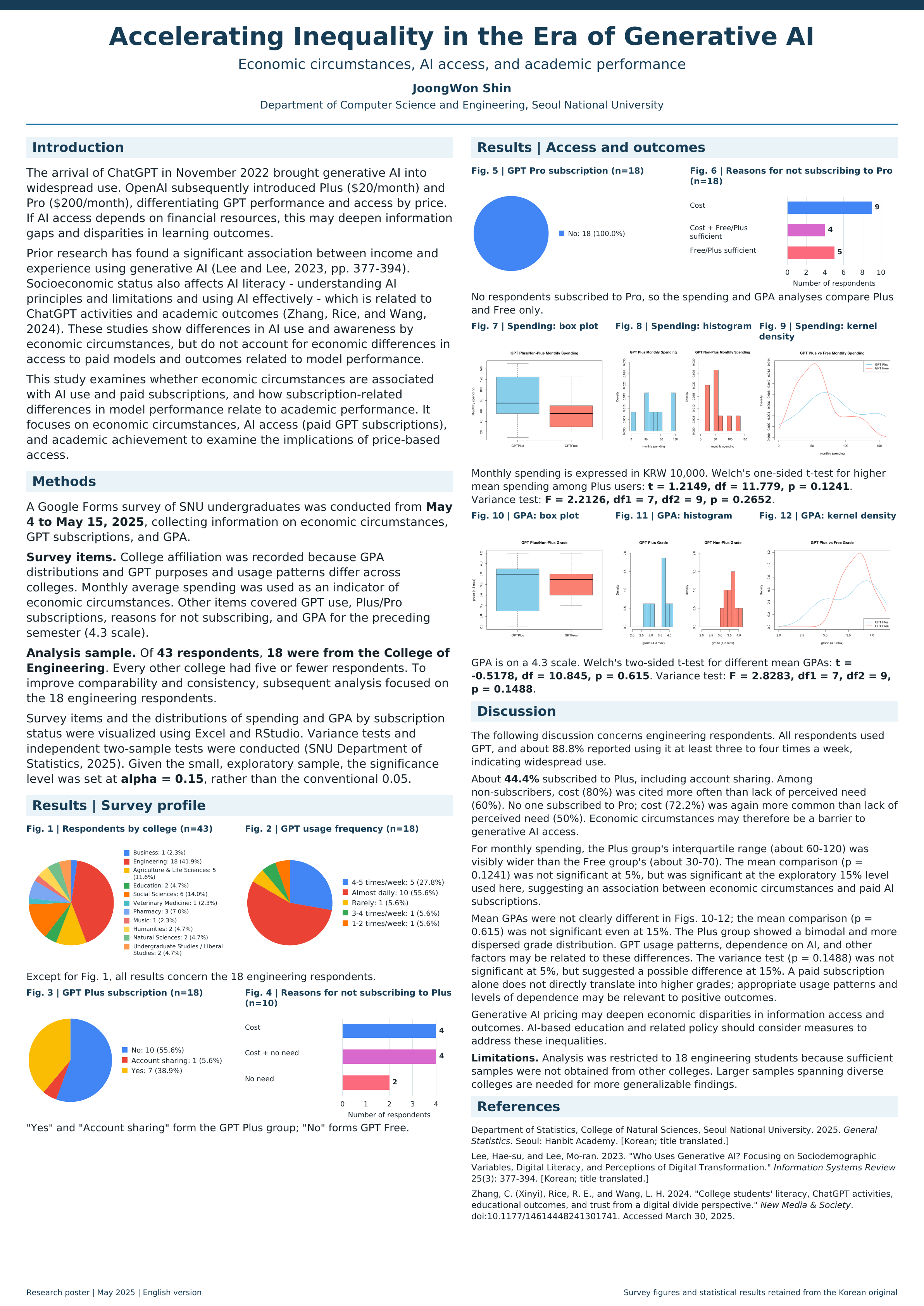
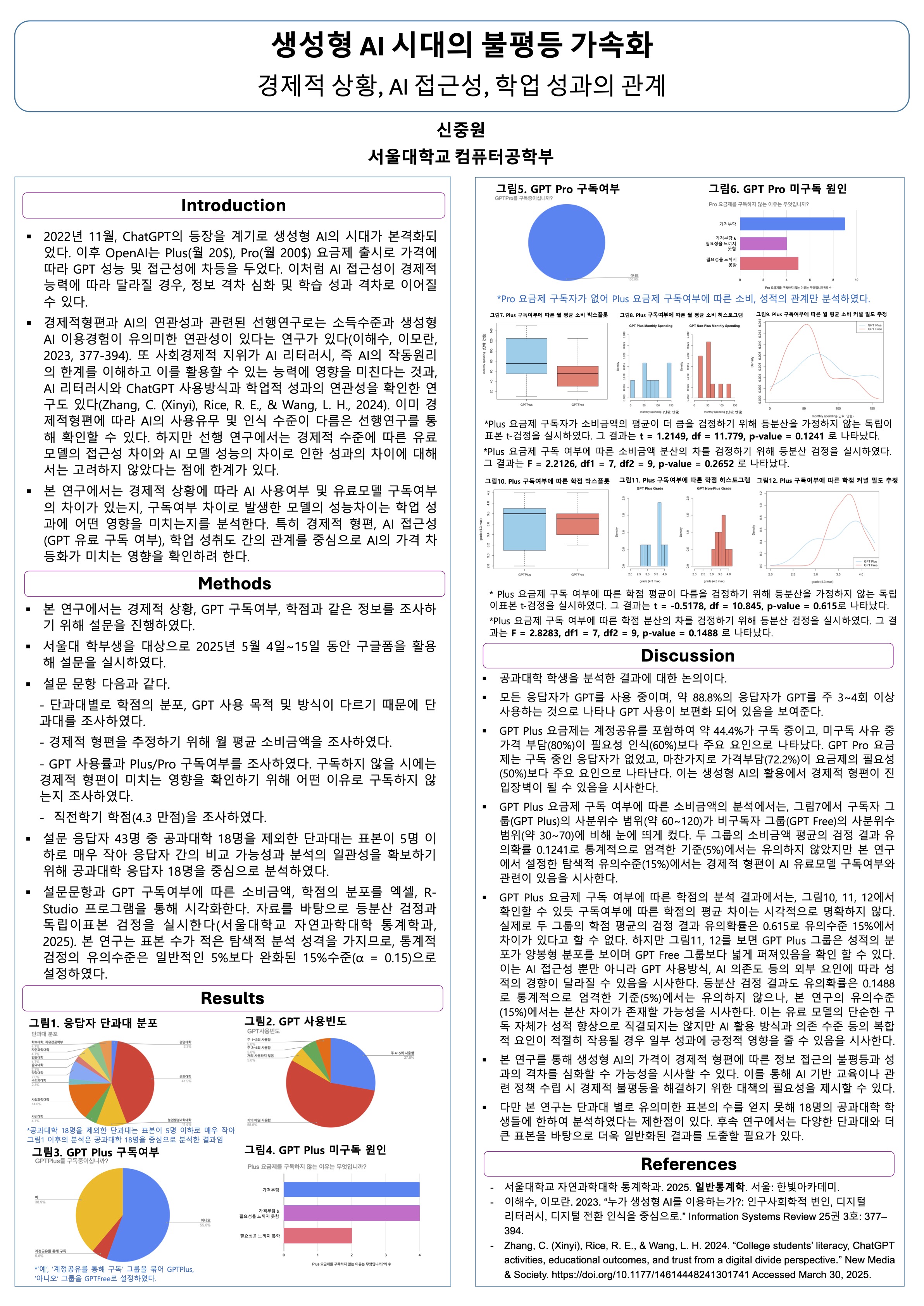
I created a research poster on accelerating inequality in the era of generative AI as a topic-based research project for College Writing 2: Writing in Science and Technology at Seoul National University.
The sections below describe the original study plan; the poster presents the completed survey and analysis.
Research Poster
English version
Korean original
1. Motivation
The arrival of ChatGPT in November 2022 marked the beginning of the generative AI era. A few months later, in February 2023, OpenAI introduced ChatGPT Plus at $20 per month, creating differences in access, including model performance and usage limits, based on subscription status. On December 5, 2024, OpenAI launched ChatGPT Pro at $200 per month. At the time of this project, accessing the highest-performing AI required a monthly payment of $200, an amount that many individuals would find difficult to afford. If using better AI requires increasingly higher spending, differences in economic circumstances could deepen disparities in AI use and model access, widening the information gap and exacerbating inequality.
Prior research has found a significant association between income level and experience using generative AI (Lee and Lee, 2023, pp. 377-394). Other research has examined how socioeconomic status affects AI literacy, meaning the ability to understand the principles and limitations of AI and use it effectively, as well as the relationships between AI literacy, ChatGPT use, and academic outcomes (Zhang, Rice, and Wang, 2024). These studies indicate that AI use and awareness already vary with economic circumstances. However, they do not account for differences in access to paid models by economic status or differences in outcomes associated with model performance.
This study examines whether economic circumstances are associated with AI use and paid-model subscriptions, and how differences in model performance arising from subscription status relate to academic performance. It focuses on the relationships among economic circumstances, AI access (paid GPT subscriptions), and academic achievement.
2. Research Objectives
- Hypothesis: Students with greater financial resources will have higher rates of generative AI use and paid subscriptions, and higher usage and subscription rates will be associated with better academic performance.
- Objective: Examine whether price-based differences in generative AI performance and access can deepen inequality.
3. Research Design
I plan to use a survey covering the following areas:
- Basic information
- Year of study and department
- Economic circumstances
- Primary indicator: Allowance plus income from part-time work
- Supplementary indicators: Living expenses, financial support, and housing arrangements (commuting, living independently, or living in a dormitory)
- ChatGPT use
- Whether respondents use it, frequency, purposes, and methods of use (copying answers, restructuring answers, or comparing and critically evaluating answers)
- Plus subscription status (currently subscribed, subscribed to another generative AI service, previously subscribed, or never subscribed)
- Financial burden of a Plus subscription, or reasons for not subscribing
- Pro subscription status
- Financial burden of a Pro subscription, or reasons for not subscribing
- Academic achievement
- GPA for the most recent semester
- Perceived effects of GPT use on academic work
The survey will be created in Google Forms and shared through Everytime, a university student community platform, and departmental group chats.
4. Expected Results and Implications
I expect to find differences in access to generative AI models by economic circumstances, and to examine whether differences in model performance and frequency of access are associated with differences in academic performance. The analysis will assess whether AI model access is a meaningful factor among the various ways economic circumstances may affect outcomes.
The findings could indicate that differences in model performance and access by economic status are associated with differences in outcomes. They could also suggest that generative AI pricing affects the information gap and that AI may deepen inequality. This would highlight the need to address such disparities when developing AI-based education and related policies.
5. Research Schedule
- By April 30: Create the survey in Google Forms
- By May 11: Distribute the survey
- May 11-23: Analyze survey responses and prepare the poster
6. References
- Lee, Hae-su, and Lee, Mo-ran. 2023. “Who Uses Generative AI? Focusing on Sociodemographic Variables, Digital Literacy, and Perceptions of Digital Transformation.” Information Systems Review, 25(3), 377-394. [Korean-language article; title translated.]
- Zhang, C. (Xinyi), Rice, R. E., and Wang, L. H. 2024. “College students’ literacy, ChatGPT activities, educational outcomes, and trust from a digital divide perspective.” New Media & Society. https://doi.org/10.1177/14614448241301741. Accessed March 30, 2025.